
27 August 2026
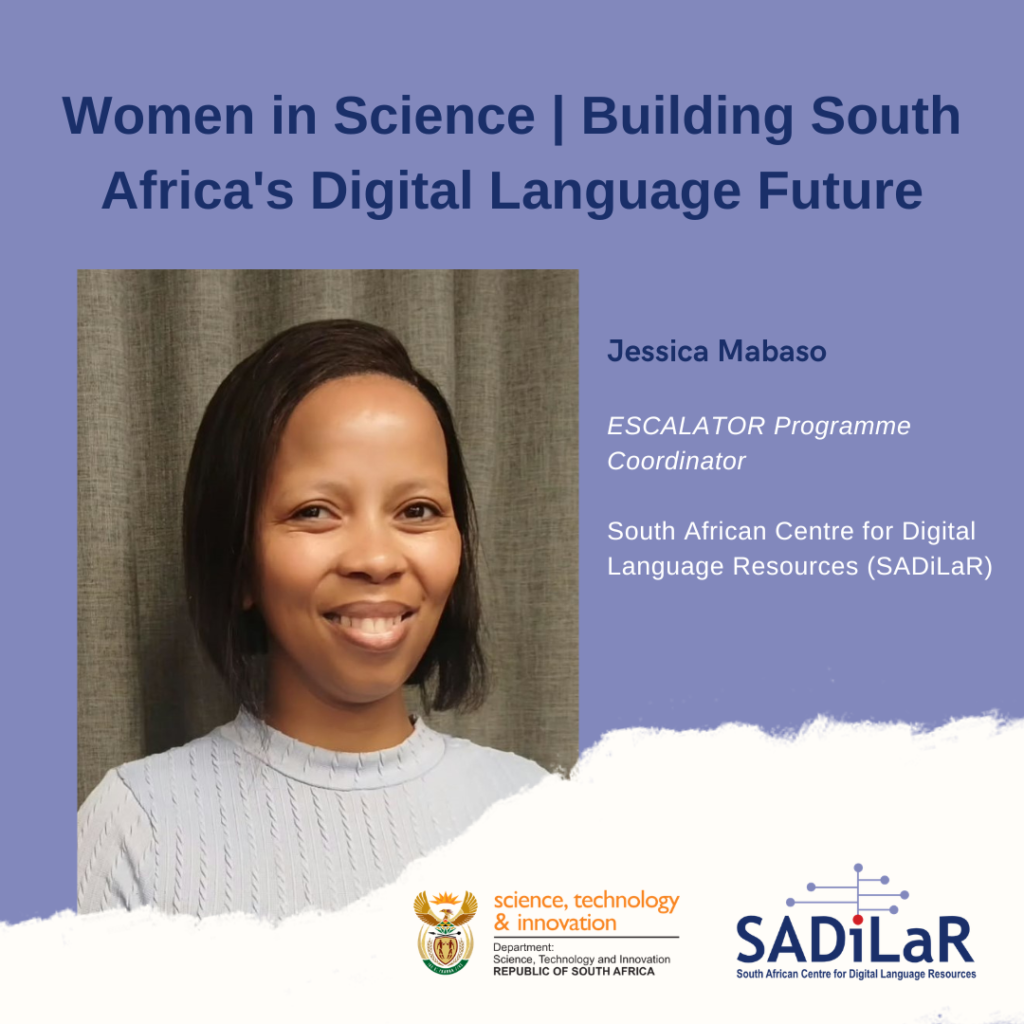
What does it take to build a resilient scientific community? Sometimes, it is not a groundbreaking discovery or a headline-making research paper. Sometimes, it is the work of bringing people together, building partnerships and creating opportunities for others to learn, connect and grow.
For Jessica Mabaso, this kind of connective work has become central to her role at the South African Centre for Digital Language Resources (SADiLaR), where she coordinates the ESCALATOR programme, which builds digital humanities and computational skills capacity at public universities across South Africa. Having stepped into the role in August 2024, Jessica now leads the programme’s workshops, DH-IGNITE events and national partnerships. Her journey into programme leadership, however, was shaped by more than 15 years of experience in higher education administration, including six years as SADiLaR’s Chief Administrative Officer.
It was her close connection to SADiLaR’s mission, to support South Africa’s official languages in the digital space, that inspired her to move from administration into programme leadership, allowing her to contribute more directly to how this mission reaches researchers and students. Today, her work focuses on building the skills, relationships and networks needed to strengthen digital humanities and computational research across the country.
One of the initiatives currently occupying her attention is the Digital Humanities Summit, a collaboration between the University of South Africa (UNISA), Nelson Mandela University (NMU) and North-West University (NWU), taking place from 7 to 9 October 2026. By creating opportunities for researchers, students and practitioners from across South Africa to exchange knowledge and strengthen connections, the Summit aims to advance work in digital humanities, computational linguistics and multilingual technology beyond individual institutions.
For Jessica, coordinating an initiative of this scale is particularly rewarding because it brings together the different elements she believes are essential to building a stronger research ecosystem: partnerships, collaboration and opportunities for people to learn from one another. At the heart of this work is a commitment to advancing research and innovation around South Africa’s official languages in the digital space.
Her journey has also demonstrated how a career can evolve in unexpected ways. One of her proudest achievements has been growing into programme leadership after years in administrative and operational roles, and seeing initiatives she helped shape, including workshops and DH-IGNITE events, influence how researchers at different universities engage with digital tools.
But with growing interest in digital humanities comes another challenge: demand. As more researchers seek opportunities to develop their digital skills, the ESCALATOR team has had to stretch its capacity while maintaining the momentum of its national programme. This experience has also offered Jessica an important lesson about resilience. “Resilience in a small programme isn’t about doing everything yourself, but about building strong relationships with colleagues and partner institutions so the work continues, even when demand outpaces capacity,” she says.
This understanding of resilience connects closely with the 2026 Women’s Month theme, “Building Resilient Economies for All.” The theme speaks directly to the purpose of ESCALATOR, which is to build skills and capacity that do not depend on a single individual or institution, but instead create value that can continue to grow across the sector.
She also believes that women in science and research administration often play a particularly important role in this process. “We are often the ones holding programmes together, building the partnerships and institutional relationships that let bigger goals like linguistic and technological inclusion actually get delivered,” she says.
Although this work may not always attract the same attention as headline research, it is essential to building a resilient scientific ecosystem. It is this belief that also shapes her advice to young women and girls considering careers in science, technology, digital humanities and research. She encourages them not to underestimate the value of the work that happens behind the scenes. Some of the most meaningful contributions to science and technology, she notes, come from people who coordinate, administer and connect, not only from those who publish research.
Her own career is evidence of the possibilities that can emerge from remaining open to new opportunities. She encourages young women to build relationships across institutions and disciplines, step into roles that stretch them and continue learning both formally and on the job. Her own investment in professional development, including completing a postgraduate diploma and a PRINCE2 certification while working full-time, has opened doors she had not originally planned for.
Looking ahead, Jessica hopes her work will contribute to a generation of South African researchers and students who are confident and self-sufficient in digital and computational skills across all South Africa’s official languages. Importantly, she wants that opportunity to extend beyond well-resourced institutions and reach researchers and students nationally.
What keeps her motivated is seeing that reach happen in practice: a workshop that changes how a postgraduate student approaches their research, or a new partnership that brings ESCALATOR’s training to a university that has not previously had access to it. For Jessica, these moments are a reminder that meaningful change is often built one connection, one opportunity and one newly acquired skill at a time
By: Tshego Rapoo-Maloyi