About the DH Summit 2026
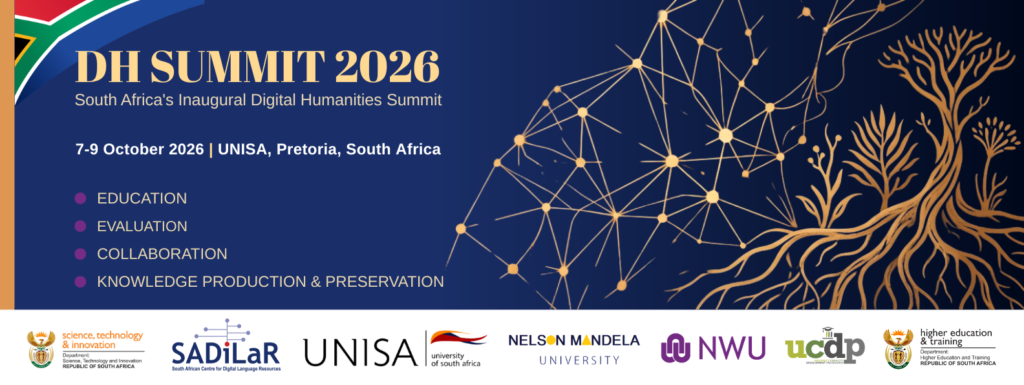
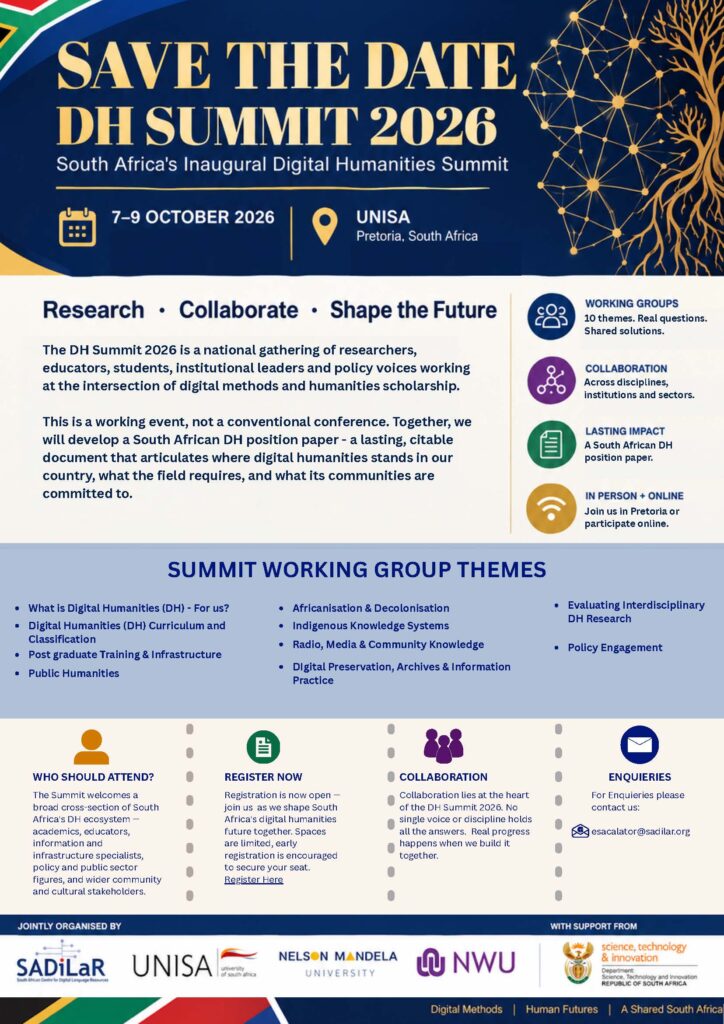
The DH Summit 2026 is a national gathering of researchers, educators, students, institutional leaders, and policy voices working at the intersection of digital methods and humanities scholarship. The summit is jointly organised by SADiLaR/ESCALATOR, UNISA, NMU, and NWU, and will be held in person at the University of South Africa (UNISA) in Pretoria, with online participation available for those who cannot attend in person.
The summit is designed as a working event, not a conventional conference. There will be no standard paper presentations. Instead, participants collaborate around shared questions and produce something of lasting value together. The summit’s primary output will be a South African DH position paper: a durable, citable document that articulates where digital humanities stands in this country, what the field requires, and what its communities are committed to.
Pre-Summit Working Groups
To ensure the summit produces substantive outcomes, a set of pre-summit working groups will be established to begin their work in advance of the October event. Each group will be assigned a focused theme or question to develop in the months leading up to the summit. When the summit opens, each group will present a short draft contribution — a position, synthesis, or set of questions — as the starting point for a facilitated session with all participants.
How it works: Participants join a small working group aligned to their area of interest. Each group meets online between June and September 2026 to develop its contribution. At the summit, the group’s contribution opens a facilitated session — a futures workshop or world café — with the wider gathering. Session outputs are synthesised and integrated into the South African DH position paper.
Working Group Themes
Eight working groups are being convened, each focused on a central question that the summit session will open up to the wider gathering.
| Theme | Working question |
| MAIN THEME | |
| What is DH — for us? | What does Digital Humanities mean in a South African, African, and Global South context — and what shared understanding can we build together? |
| MACRO GROUP 1: EDUCATION | |
| DH Curriculum and Classification | How should DH be classified in South Africa’s CESM system — and what would a nationally recognised DH curriculum framework look like? |
| Postgraduate Training and Cross-Institutional Infrastructure | Could a NEPTTP-style model support a cross-institutional DH postgraduate programme — and what would it take to make that happen? |
| MACRO GROUP 2: KNOWLEDGE PRODUCTION & PRESERVATION | |
| Public Humanities | How does DH connect with communities, civic engagement, and publicly oriented knowledge production beyond the university? |
| Africanisation, Decolonisation, and Indigenous Knowledge | What does a genuinely African DH practice look like — and how do frameworks of decolonisation and indigenous knowledge reshape the field? |
| Radio, Media, and Community Knowledge | How does DH engage with radio and digital media as sites of knowledge production from and for communities? |
| Digital Preservation, Archives, and Information Practice | How do we preserve, curate, and provide access to South African knowledge heritage in digital environments — and what roles do librarians, archivists, and information professionals play in shaping DH practice? |
| MACRO GROUP 3: EVALUATION | |
| Evaluating Interdisciplinary DH Research | How do we evaluate and recognise DH outputs within institutional reward structures — and what criteria should guide that assessment? |
| MACRO GROUP 4: COLLABORATION | |
| Policy Engagement | How do we bring DH into formal policy conversations with DHET, CHE, and national funders — and what does the field need to make that case? |
SAVE THE DATE
About the Organising Partnership
The DH Summit 2026 is jointly organised by the following institutions:
- SADiLaR — South African Centre for Digital Language Resources, hosted at North-West University
- UNISA — University of South Africa, Advancing African DH Ideation Hub
- NMU — Nelson Mandela University, DH Hub
- NWU — North-West University, Centre for Digital Humanities
The summit is the first in what the organising partnership intends to develop as a regular national gathering — a community of practice that collaborates between events as well as during them. The position paper produced in October 2026 will serve as a living document and a starting point for sustained engagement with DHET, CHE, national infrastructure bodies, and the international DH community.
Enquiries
For any questions regarding the working groups or the application process, please contact Jessica Mabaso, ESCALATOR Programme Coordinator, jessica.mabaso@nwu.ac.za.
