SADiLaR amplifies visibility and impact during conference season

9 December 2025

The South African Centre for Digital Language Resources (SADiLaR) experienced a notable enhancement in visibility and outreach during 2025, primarily due to the active participation of its digital humanities researchers and operational teams at various conferences and events throughout the year.

This increase in engagement aligns closely with the research infrastructure’s long-term vision to create a more inclusive digital future for South Africa’s official languages. Below is a selection of events in which SADiLaR featured prominently during 2025.

International footprint

NAACL 2025 Conference, Albuquerque, 29 April–4 May 2025

Digital humanities researchers Rooweither Mabuya and Andiswa Bukula attended the 2025 Annual Conference of the Nations of the Americas Chapter of the Association for Computational Linguistics (NAACL) 2025 in Albuquerque, New Mexico, USA. Both participated in oral presentations of two papers – “IrokoBench: A New Benchmark for African Languages in the Age of Large Language Models” and “AfriHate: A Multilingual Collection of Hate Speech and Abusive Language Datasets for African Languages” – which they co-authored together with other researchers.

ECAS Conference, Prague, 25–28 June 2025 

SADiLaR’s digital humanities professor Menno van Zaanen represented SADiLaR at the European Conference on African Studies (ECAS) in Prague, Czech Republic, where he shared his expertise in a presentation titled “Taking the ESCALATOR from Humanities to Digital Humanities”. The conference invited scholars to think critically about Africa and to encourage the transcendence of disciplinary boundaries.

ADHO Digital Humanities Conference, Lisbon, 14–18 July 2025

Menno Van Zaanen, along with operations director Juan Steyn, presented a paper on open science and digital humanities practices at the Alliance of Digital Humanities Organisations (ADHO) Conference held in Lisbon, Portugal. The conference theme, “Building Access and Accessibility: Open Science for All Citizens”, aligned well with SADiLaR’s objectives.

G20 Conference, Interaction of Culture and Climate side event, Cape Town, 25 July 2025 

Prof Langa Khumalo, SADiLaR’s chief director, participated as a panellist alongside global thought leaders at a G20 side event themed “Interaction of Culture and Climate” in Cape Town. In his presentation, titled “Exploring Intersections Between Language, Culture, and Climate Change in the South African Context”, he emphasised that “monolingualism is the bane of our human existence” and reminded attendees that “we are poorer without the inclusion of our African languages, cultures, and knowledge systems in the global knowledge economy”.   

LAEA Conference, Dodoma, 13–15 August 2025

SADiLaR digital researchers and senior lecturers Drs Muzi Matfunjwa and Respect Mlambo presented papers at the Language Association of East Africa (LAEA) Conference, hosted by the University of Dodoma in Tanzania. The theme of the conference was “Languages’ role in social transformation, promotion of African values, and assisting communities in facing challenges of resilience and sustainable development”.

UNESCO Digital Learning Week, Paris, 2–5 September 2025 

In September, Prof Langa Khumalo, co-presented a paper titled “Reimagining education in South Africa in the age of AI: complexities of structural equity and inclusion” at UNESCO’s Digital Learning Week in Paris, France. The discussions aimed to chart pathways for equitable, ethical, and human-driven AI integration in education, ensuring that technology becomes a force for inclusive progress. 

G20 Language and Cultural Resilience side event, Luthuli Museum, KwaZulu-Natal, 23 October 2025

SADiLaR participated in the G20 Language and Cultural Resilience side event at Luthuli Museum in KwaZulu-Natal. This session aimed at bringing together global leaders to advance collaboration in culture, sustainability, and innovation. Mr Juan Steyn moderated this panel discussion which was titled “Language and Communication”.

The 53rd New Ways of Analyzing Variation (NWAV 53) Conference, University of Michigan, Ann Arbor, USA, 5-7 November 2025

Deon du Plessis, Digital Humanities Researcher at SADiLaR specializing in English, participated in this prominent annual event that focuses on language variation, social dynamics, and peace building. This event attracts linguists from around the world for presentations and discussions on language change and usage. Du Plessis presented his PhD work titled “Shifting Sounds, Shifting Selves: Diphthong Variation and Social Meaning in Afrikaans.”

National impact

SADiLaR played a prominent role in several local conferences and events from January to December,  in an organising, participating, and funding capacity.

Annual NextGen Career Expo, Mabeskraal, North-West, 31 January 2025

SADiLaR collaborated with the South BRICS Youth Association for the Annual NextGen Career Expo, which took place in Mabeskraal, North-West. At this event, high school students had the opportunity to engage with the SADiLaR team and learn about the various career options and opportunities available in the fields of digital humanities and computational linguistics.

!Xu Language Conference, Platfontein, Northern Cape, 11 April 2025 

The !Xu Language Conference, hosted by SADiLaR in the small community of Platfontein near Kimberley in the Northern Cape, highlighted the critical role of digital resources in protecting and celebrating South Africa’s linguistic heritage. A special presentation on books written in !Xu, by Dr Kerry Jones, sparked an interesting discussion about grammar errors and dialect variations.

Ipokelleng Career Day 2025, Fouriesburg, Free State, 12 April 2025

The SADiLaR team collaborated with industry leaders such as TRANSET, Flagg Consulting Engineering, and KBK Engineering to inspire Grade 11 and 12 learners from Mashaeng. Prof Menno van Zaanen presented exciting career opportunities in the digital humanities field. Students had the chance to engage with professionals, explore exhibitions, and network during this event, creating connections that could shape their future

MASA 5th Annual Career Expo, Limpopo, 10 May 2025

SADiLaR collaborated with the Maths and Science Academy (MASA) Career Expo, where learners were motivated and inspired by various guest speakers. Career opportunities in the field of digital humanities were showcased.

SALALS Conference, Gqeberha, 25–27 June 2025  

The 2025 Southern African Linguistics and Applied Linguistics Society (SALALS) Conference, held at Nelson Mandela University and funded by SADiLaR, brought together national and international experts to explore the intersection of language, society, and innovation under the theme “Traditions, transformations, and African thought: Imagining Linguistics in Africa for the 21st century”.

IAFLL Conference, Cape Town, 30 June–4 July 2025  

SADiLaR sponsored the 17th Biennial International Association for Forensic and Legal Linguists (IAFLL) Conference, which was hosted for the first time on the African continent, at the University of the Western Cape. Themed “Transformative Justice Through a Forensic and Legal Linguistics Lens”, the conference welcomed presentations in isiXhosa and Afrikaans, alongside English.

Afrilex Conference, Cape Town, 1–5 July 2025

The 29th International Conference of the African Association for Lexicography (Afrilex), took place at the University of the Western Cape, under the theme “The Role of Artificial Intelligence and Digitalisation in the Future of Lexicography”. Sponsored by SADiLaR, the conference had a strong focus on artificial intelligence (AI) and its implications for lexicographic theory and practice.

SAALT Annual Conference, Skukuza, 29–31 July 2025

Themed “From Chalkboards to Chatbots: The Language Education Journey”, the SADiLaR-sponsored annual conference of the South African Association for Language Teaching (SAALT) captured the evolution of language education from traditional methods to the latest technological advancements.

International Language Conference, Kimberley, 27–29 August 2025 

The International Language Conference, sponsored by SADiLaR and hosted at Sol Plaatje University, invited participants to engage with the topic of “Intellectualisation of African Languages in the Digital Age”. Marissa Griesel, project manager for the African Wordnet and Multilingual Terminology projects at SADiLaR, delivered a keynote address that shared insights on how community-focused approaches to language technology can create relevant resources that serve both computational needs and cultural requirements.

SASRIM Conference, Stellenbosch, 26–28 September 2025 

Hosted at Stellenbosch University with financial support of SADiLaR, the 19th annualSouth African Society for Research in Music (SASRIM) conference invited future-orientated papers that grapple with the opportunities and risks posed by the acceleration of advancement in computing technologies. As a result, the conference attracted contributions that dealt specifically with artificial intelligence and machine learning in the cultural sphere.

FDCR2025 Conference, Umhlanga, 15–18 July 2025

The Foundational Digital Capabilities Research (FDCR) Conference served as a call to action for science and technology to lead the development of resilient, inclusive, and environmentally conscious digital systems. A DH-IGNITE workshop and tutorial, presented by SADiLaR, introduced participants to the rapidly evolving field of digital humanities and computational social sciences.

Third Indigenous Languages and the Media Seminar, University of Limpopo, 13–14 August 2025

Under the theme “Redefining storytelling in a digital age”, SADiLaR’s Juan Steyn presented and discussed the SWiP project, “Preserving Languages: Open, Free and Accessible Knowledge for All”, which focuses on expanding the presence of South African languages online. The project has progressed from training new authors and recognising isiNdebele as an official language to supporting further workshops and training. Mr Steyn concluded by calling for collective action, stating that “together we can enable and make transformative use of our languages possible”.

VUT Teaching and Learning Conference, Vanderbijlpark, 9–11 September 2025 

SADiLaR participated in the Vaal University of Technology (VUT) Teaching and Learning Conference in Vanderbijlpark, Gauteng. Themed “Innovating Education for an Inclusive Future”, the conference emphasised the need for educational innovation that addresses inclusivity, transformation, and future readiness in the higher education landscape.

LSSA Conference, Johannesburg, 19–22 August 2025 

The inaugural Linguistic Society of South Africa (LSSA) Conference brought together linguistic scholars and practitioners to reflect on language policy, decolonisation, and the future of African linguistics. The keynote address was delivered by Prof Langa Khumalo, who challenged attendees to rethink the relationship between language, education, and our digital future.

International Dictionary Day celebration, Thohoyandou, 15 October 2025

Prof Langa Khumalo joined Google South Africa and the Pan South African Language Board (PanSALB) as a guest speaker at the launch of the Artificial Intelligence (AI) Glossary, a ground-breaking initiative that bridges technology and linguistic diversity. In his address, Prof Khumalo celebrated this partnership and highlighted that findable technical terminology as a resource is an essential building block that unlocks and enhances downstream innovation. Excitingly, Google also agreed for SADiLaR to integrate this terminology into its LWIMILINKS platform, further empowering multilingual access to AI knowledge.

Sign Language Workshop for Frontline Workers, Moruleng, North-West, 21–24 October 2025

In partnership with the Department of Arts, Culture, Sport, SADiLaR held and funded a four-day sign language workshop for frontline workers, representing various stakeholders from the Moses Kotane Municipality. The workshop, held at the Mphebatho Museum in Moruleng, aimed to promote effective communication and inclusivity in service delivery. This initiative forms part of SADiLaR’s ongoing efforts to support, raise awareness and equip communities with basic South African sign language skills to improve interactions with the deaf and hard-of-hearing community.

DHASA Conference and RAIL Workshop, Pretoria, 11–14 November 2025

The keynote was delivered by Iginio Gagliardone, titled “Infrastructures of Belonging: Experimentation, Activism, and Futures from the African Continent”. SADiLaR contributed to proceedings with an executive summary presentation at Xitsonga Corpus Building by Respect Mlambo (senior lecturer with a focus in Xitsonga), and Juan Steyn. An engaging workshop on “Bantu Languages Processing Tools” was presented by Drs Laurette Marais and Laurette Pretorius.

UFS International Conference on Languages, Multilingualism & Decolonisation, University of the Free State, 26 November 2025

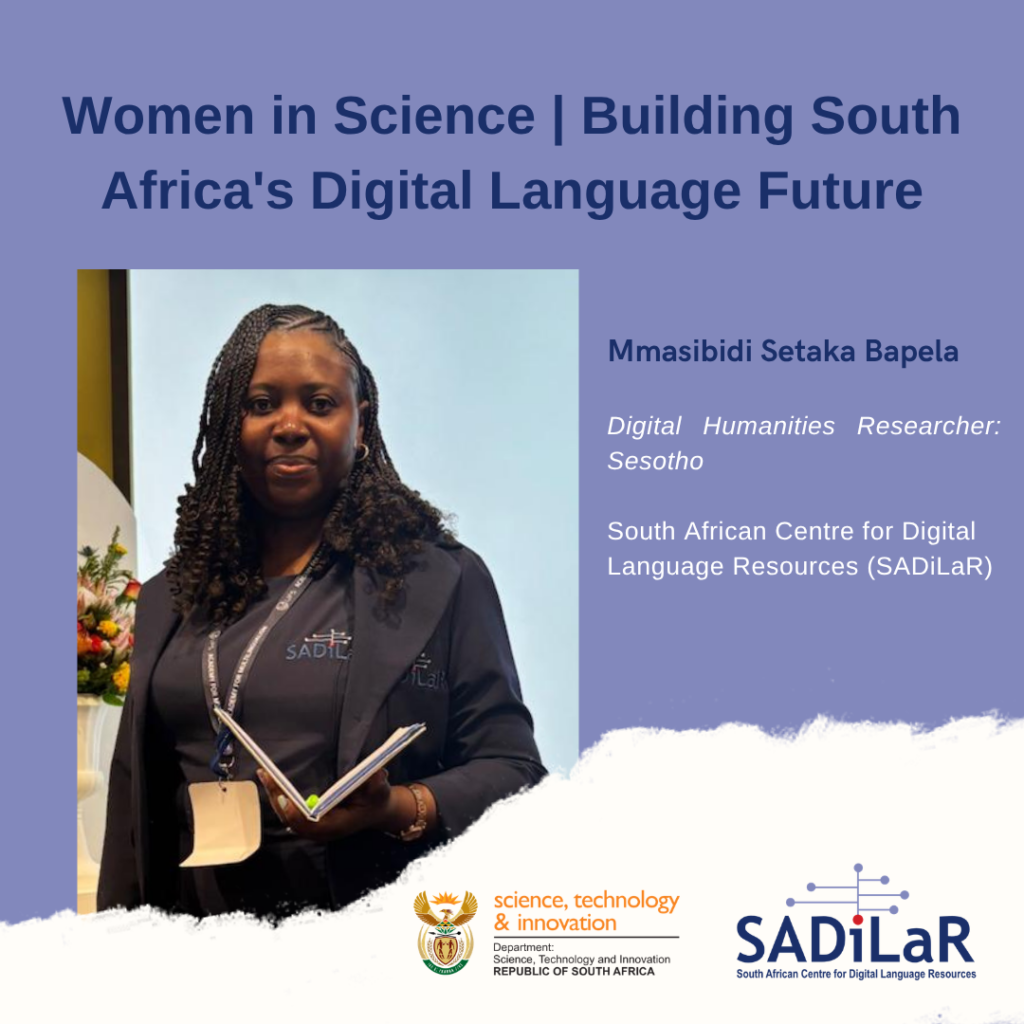
SADiLaR is proud to have partnered with the University of the Free State for the second International Conference on Languages, Multilingualism and Decolonisation Practices in Higher Education. This was a dynamic three-day gathering of scholars, practitioners, and thought leaders committed to transforming the linguistic landscape of higher education. Mmasibidi Setaka Bapela, digital humanities researcher in Sesotho, showcased “SADiLaR Digital Language Resources”, highlighting innovative tools and research advancing language access, preservation, and computational linguistic development. Thato Bambo, senior administrative officer at SADiLaR, delivered an engaging session on “Introduction to ESCALATOR”, unpacking this national capacity development initiative designed to grow digital humanities and computational research skills in South Africa.

Science Forum South Africa, 24–26 November 2025     

Under the theme “Placing science, technology and innovation at the centre of government, education, industry and society”, SADiLaR participated in an exhibition in this forum that brought together thought leaders for 91 high-level panel discussions on science diplomacy, inclusive innovation, disruptive technologies, science journalism, entrepreneurship, research capacity-building, and the Astronomical Unit,  Science, Technology and Innovation Strategy for Africa 2034.

Centre for High Performance Computing Conference, Cape Town, 1–3 December 2025

In December, SADiLaR participated in the Centre for High Performance Computing Conference at the Century City conference centre in Cape Town. There, SADiLaR announced the launch of a brand-new research software awards category, now part of the prestigious NSTF-South32 Awards, South Africa’s very own “science oscars”. The award category celebrates excellence in developing, enhancing, or maintaining research software that drives South Africa’s research landscape forward.

Workshops and training

SADiLaR hosted numerous workshops under its ESCALATOR flagship programme. Monthly digital humanities DH Colloquiums took place, as well as several workshops to strengthen the digital capabilities of South African researchers (especially for those who work in the humanities field).

FDCR2025 Conference, Umhlanga, 15–18 July 2025

The Foundational Digital Capabilities Research (FDCR) Conference served as a call to action for science and technology to lead the development of resilient, inclusive, and environmentally conscious digital systems. A DH-IGNITE workshop and tutorial, presented by SADiLaR, introduced participants to the rapidly evolving field of digital humanities and computational social sciences.

VUT Teaching and Learning Conference, Vanderbijlpark, 9–11 September 2025 

SADiLaR participated in the Vaal University of Technology (VUT) Teaching and Learning Conference in Vanderbijlpark. Themed “Innovating Education for an Inclusive Future”, the conference emphasised the need for educational innovation that addresses inclusivity, transformation, and future-readiness in the higher education landscape.

LSSA Conference, Johannesburg, 19–22 August 2025 

The inaugural Linguistic Society of South Africa (LSSA) Conference brought together linguistic scholars and practitioners to reflect on language policy, decolonisation, and the future of African linguistics. The keynote address was delivered by Prof Langa Khumalo, who challenged attendees to rethink the relationship between language, education, and our digital future.

Embracing bi/multilingualism in foundation and intermediate phases in the digital age workshop, University of the Witwatersrand, 8 October 2025

This collaborative workshop was funded by SADiLaR’s ESCALATOR programme in partnership with the Department of Science, Technology and Innovation. Its aim was to equip pre-service teachers with the knowledge and digital age skills to effectively implement bi/multilingual education policies in the foundation and intermediate phases. The workshop responded to challenges identified by teachers working in multilingual classrooms. The sessions demonstrated practical tools including the African Storybook platform, text-to-speech technology in South African languages and recording applications for classroom use.

Introduction to artificial intelligence (AI) workshop, University of KwaZulu-Natal, Durban, 14–15 October 2025

This was a collaborative workshop hosted by the University Capacity Development Programme, the University of Language Planning and Development Office, and SADiLaR’s ESCALATOR programme. Marissa Griesel from SADiLaR led the sessions with interactive and practical presentations that explored available AI and language tools, demonstrating how to download glossaries from the SADiLaR repository and integrate them into Autshumato, making digital linguistic resources accessible for everyday use. She also led a session introducing machine translation (MT), highlighting the vital role of linguists in refining MT systems, and guiding participants through comparisons of free MT and AI tools for translation and language work. A critical discussion took place on ethical considerations for using AI-generated translations, emphasising responsible data practices, quality assurance, and preserving the human touch in digital translation.

Digitisation workshop, Vaal University of Technology, 23 October 2025

SADiLaR hosted a digitisation workshop at the Vaal University of Technology on 23 October 2025, a day dedicated to empowering participants with the knowledge and skills needed to thrive in the ever-evolving digital age. Facilitated by Dr Michelle Goosen, project manager of the digitisation node at Pretoria University, the workshop sparked insightful discussions about digital transformation and its growing impact across industries.

SAHUDA Conference, Walter Sisulu University, Mthatha, 22–24 October 2025

SADiLaR’s ESCALATOR programme ran the “Digital Humanities and Emerging Technologies” track at this year’s SAHUDA Conference, a dynamic platform exploring how digital innovation continues to transform research, teaching, and collaboration in the humanities.

Preserving Languages: Open, Free, and Accessible Knowledge for All workshops, May-December 2025

In partnership with Wikimedia South Africa and PanSALB, SADiLaR continued with the hosting of SWiP workshops at several universities. These workshops were aimed at building a future where knowledge is open, free, and accessible to all. A highlight was a two-day workshop organised by the University of Eswatini at King Sobhuza II Memorial Park, marking a significant milestone in engaging with southern African language communities beyond South Africa. 

ESCALATOR Enthusiast track online meeting, 27 October 2025

Through ESCALATOR, SADiLaR hosted an ESCALATOR “Enthusiast track” online meeting, which was open to digital humanities and computational social science enthusiasts who are passionate about advancing digital humanities and computational social sciences in South Africa. This meeting allowed participants to contribute their ideas in programme overview and collaboration opportunities, community engagement and networking, and to plan exciting 2026 initiatives together to shape the future of ESCALATOR.

By Birgit Otterman and Lihle Sosibo