
30 March 2026
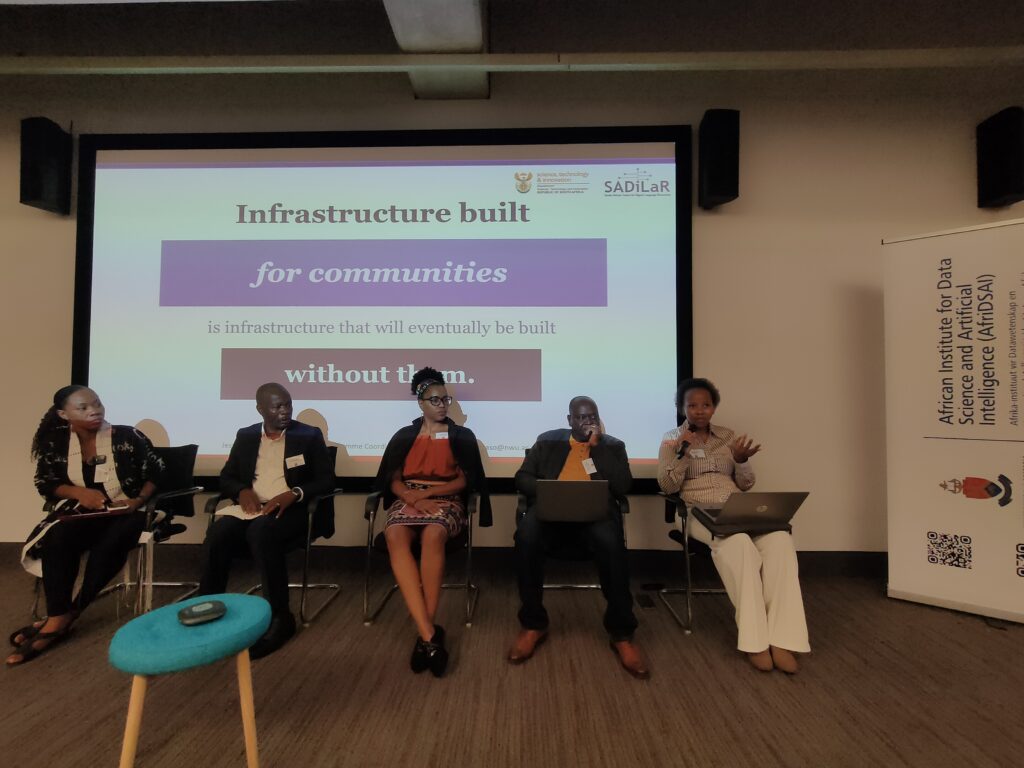
SADiLaR’s ESCALATOR programme had the privilege of joining a panel at the AI4D African Language Lab Workshop, held at the University of Pretoria on 25 March 2026. The panel discussion, titled “Bridging Research and Reality: The Content Pipeline”, brought together diverse voices committed to making language technology work for under-resourced African languages.
Jessica Mabaso, ESCALATOR Programme Coordinator, spoke about how inclusive language infrastructure can look in practice. At the heart of her contribution was a call for researchers to engage with communities in genuinely meaningful ways by not simply extracting value from them but by investing back into them.
This philosophy is reflected in how ESCALATOR approaches capacity-building. Rather than hosting one-off workshops that leave participants without continued support, ESCALATOR builds self-sustaining communities of practice. Recent examples include the Digital Text Analysis & Annotation Workshop hosted in February at the University of the Free State, and the Corpus Creation & Text Processing Workshop at the University of Zululand in March. Both demonstrate the programme’s commitment to creating inclusive, lasting language infrastructure.
This commitment was further reflected in research presented at the workshop by PhD student Penelope Matloga, who used the SADiLaR repository to access farming data while exploring strategies for optimising pseudo-labelling and improving model robustness in code-switched settings.
The workshop served as a timely reminder for those in the room and those joining online, that the time for talking must give way to the time for doing. As Ms Mabaso put it, the goal is not to still be discussing aspirations in five years’ time, but to look back at what has actually been built. The challenge is to step out of comfortable silos and engage meaningfully across disciplines.
Ms Mabaso closed with a thought that is, in truth, an invitation: “Infrastructure built for communities will eventually be built without them.” It is a call to open space for genuine co-creation and data sovereignty, where communities retain the right to determine who accesses their language data, on what terms, and who stands to benefit both commercially and academically.
Later that evening, Prof Langa Khumalo addressed those gathered to celebrate and reflect on the work of the AI4D African Language Lab. Joined by key funders and strategic partners, the conversation turned to the collective impact of the AI4D initiative and the vital role that national research infrastructures like SADiLaR play in sustaining this work over the long term.
The contributions of both Prof Khumalo and Ms Mabaso carried a shared conviction: that deliberation is giving way to delivery. Building inclusive language infrastructure for African languages is no longer an ambition; it is an ongoing responsibility, with communities firmly at the centre.
By: Noxolo Chalale