6 March 2026
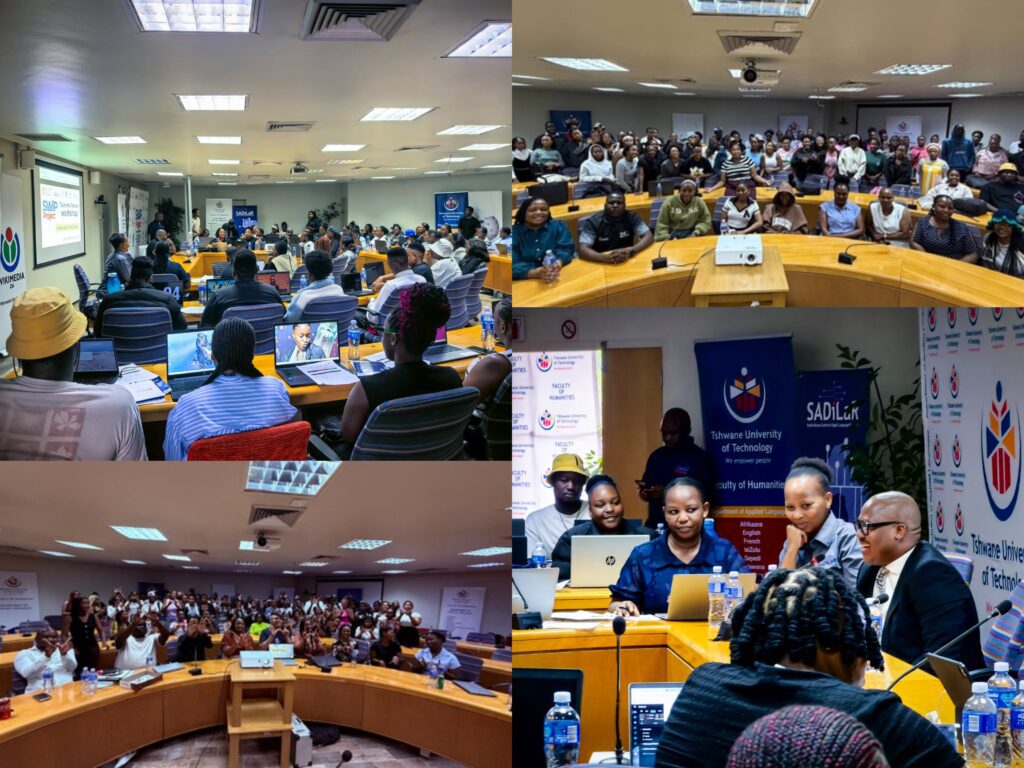
The SWiP project, in collaboration with the Tshwane University of Technology (TUT), hosted another successful intensive six-day SWiP and Train-the-Trainer Workshop as part of students’ work-integrated learning (WIL). The workshop took place from 23 to 28 February 2026 at the Soshanguve South Campus of Tshwane University of Technology.
Attended by over 240 students, the workshop empowered third-year language practice students with hands-on practical skills aligned with their WIL requirements. It equipped them not only as contributors but also as future trainers in the digital knowledge space, thereby increasing their employability opportunities within the digital sector.
A Strategic Vision for Societal Impact
In his welcome address, Prof Tebogo Rakgogo, Head of the Department of Languages at TUT, opened with a quotation from the Executive Dean of the Faculty of Humanities, Prof Mashupye Maserumule, who regards the project as part of the decoloniality agenda aimed at advancing linguistic justice.
Prof Rakgogo emphasised the strategic importance of the SWiP project in preparing students for the evolving digital language landscape. He celebrated the remarkable achievement of students who contributed 140,000 new words to Wikipedia in 2024, which was a milestone that demonstrated both the commitment and technical capability of TUT students to contribute to large language models.
Looking ahead, he set an ambitious target of 500,000 new words for the current academic year, signalling TUT’s strong commitment to expanding South Africa’s digital language footprint. He further emphasised that TUT is the first university to integrate the SWiP and Train-the-Trainer Workshop into its curriculum, specifically within the language and translation module, which includes practical components in translation and language editing.
He stated that the workshop aligns closely with TUT’s strategic pillars, as it introduces innovative approaches to practical translation and language editing. In conclusion, he expressed his satisfaction at seeing TUT students at the forefront of innovative language education and digital authorship training, describing it as an essential contribution to the scientific development of South African indigenous languages.
Understanding Wikipedia’s Role in Language Preservation
Mr Dumisani Ndubane from Wikimedia South Africa delivered an engaging session on Wikipedia. He unpacked:
- the history and evolution of Wikipedia,
- the five pillars that guide Wikipedia’s content and community, and
- the broader Wikimedia community support structures and projects.
Importantly, he addressed the critical issue of language preservation in the digital era, noting that any language not present in digital spaces risks disappearing within the next 20 years. He highlighted that Wikipedia represents all official languages of South Africa, reinforcing its role as a powerful platform for linguistic inclusion and cultural preservation.
He further emphasised Wikipedia’s commitment to publishing notable and verifiable information in a neutral and unbiased manner, a principle that aligns strongly with academic integrity and professional language practice.
Tangible Results, Measurable Growth
The impact of the six-day workshop was both immediate and measurable:
- Two hundred and fifty-nine (259) newly enrolled Wikipedia editors
- Seven hundred and eighty-two (782) new articles created
- Eight hundred and forty-one (841) existing articles edited.
These figures go beyond mere statistics. They represent students actively shaping the digital knowledge ecosystem in their own African languages (Afrikaans, isiZulu, Sepedi, Setswana, Tshivenḓa, and Xitsonga). Through their contributions, they advance public scholarship and strengthen South Africa’s multilingual digital presence.
In just six days, TUT students added 2.24 million bytes to Wikipedia, which equal approximately 407,000 new words. This represents a significant resource for large language models and contributes meaningfully to the advancement of digital language resources in South Africa. Institutions are encouraged to support similar initiatives to safeguard and promote the sustainability of African languages.
Strengthening the Next Generation
Through this collaboration, SWiP and TUT are not only advancing WIL but also cultivating digitally skilled language professionals who understand the power of open knowledge platforms.
Together, they are strengthening language capacity, expanding digital representation, and supporting the next generation of language practitioners to lead confidently in the digital age.
More About SWiP
The SWiP project is a national collaborative initiative between the SADiLaR, Wikimedia South Africa, and PanSALB.
SWiP promotes the preservation, development, and digital visibility of South African languages by empowering communities to create and expand content on Wikipedia in their own languages. Learn more about SWiP here.
By: Lihle Sosibo