
01 July 2026
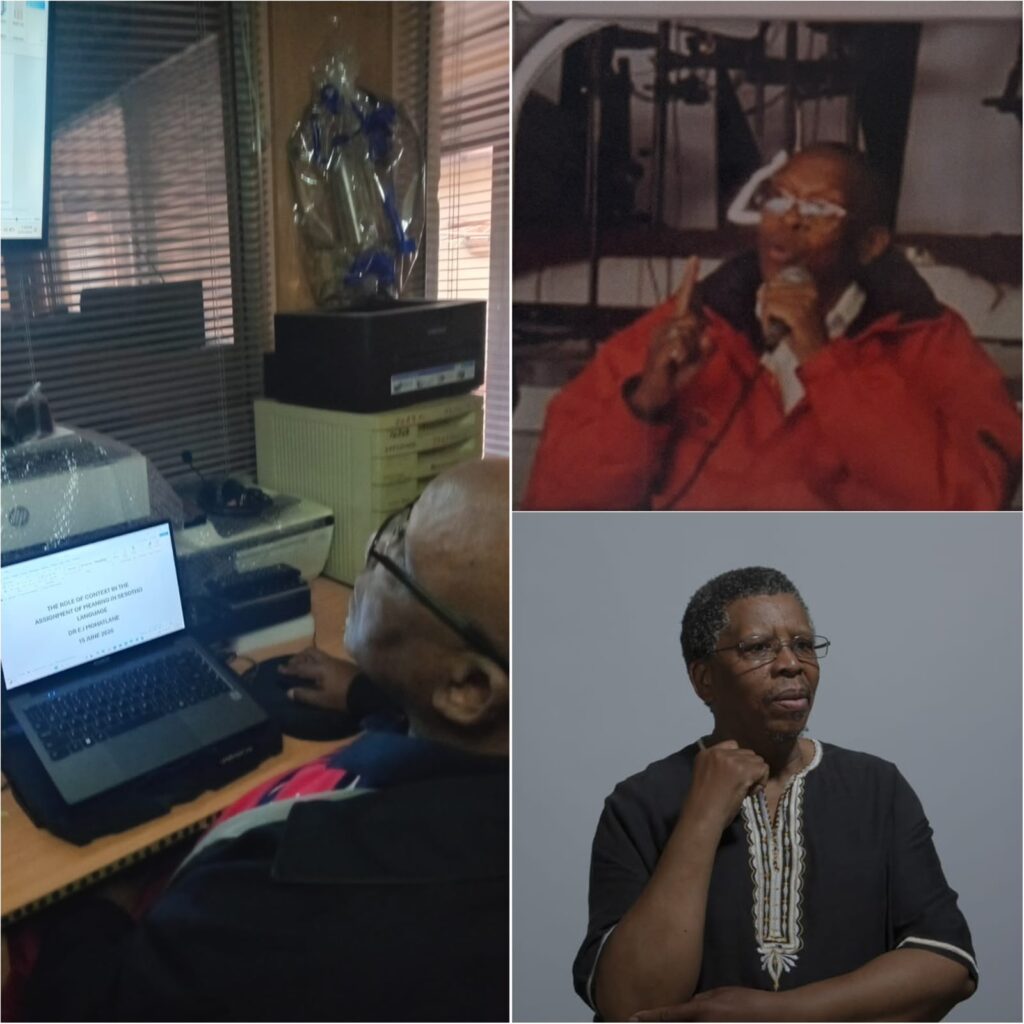
Frame 2 (top right): Mr Florian Mohapi presenting research on Basotho history, traditions, language, and cultural heritage during a National Department of Arts and Culture research project.
Frame 3 (bottom right): Mr Winston Mohapi, pictured in a portrait, recognised for his contribution to the preservation and promotion of Basotho language and cultural heritage.
The African Wordnet Project demonstrates that preserving and advancing indigenous languages requires contributions from people across many disciplines. Within the Sesotho African Wordnet team, linguists, translators, educators, broadcasters and language activists are working together to ensure that Sesotho remains relevant, accessible and technologically enabled for future generations.
Three members of the Sesotho African Wordnet team, Dr Mohatlane, Mr Florian Mohapi and Mr Winston Mohapi, exemplify how different professional journeys can collaborate towards a shared passion for language development.
For Dr Mohatlane, a linguist and literary scholar, the project represents an opportunity to strengthen the role of Sesotho in the digital age. Having dedicated much of his academic career to the study and teaching of Sesotho language and literature, he sees the Sesotho Wordnet as a vital tool for ensuring that the language continues to develop and maintain its status as a language of science and learning.
“Participation in this project is precisely to have an impact in ensuring that Sesotho language features technologically in AI,” he explains. He is particularly fascinated by the lexical relationships that the Wordnet makes visible, such as entailment (where a specific word is assumed to happen within the context of another. For example: It is already implied or assumed that dreaming (ho lora) and snoring (ho kgona) are actions entailed in sleeping (boroko). For him, these relationships reveal the richness and complexity of Sesotho while providing valuable resources for language teaching, translation and research.
Mr Florian Mohapi brings a different but equally valuable perspective. With more than three decades of experience at the South African Broadcasting Corporation (SABC), he has spent his career promoting Sesotho through broadcasting, translation, language practice and cultural preservation. As a language activist and advisor, Mr Mohapi has worked extensively to support indigenous language development and terminology creation in South Africa.
His enthusiasm for the African Wordnet project stems from its ability to capture words and concepts that might otherwise be forgotten. He describes the work of developing synsets as both exciting and deeply rewarding, particularly when documenting unique cultural concepts and traditional knowledge embedded in the language. Examples such as kgongwanatsingwana illustrate how wordnet can preserve linguistic and cultural heritage while making it accessible to future generations. In this example, the noun kgongwanatsingwana refers to a barren woman who would be instructed to carry a baby made from clay. This baby would be smeared with the juice of the herb” kgongwanatsingwana”. She would be referred to as a woman who curdles “kgongwanatsingwana”.
For Mr Winston Mohapi, an accomplished educator, translator, editor and author of more than twenty books, development of the African Wordnet project represents an important milestone in the evolution of Sesotho. Throughout his career, he has contributed significantly to translation, editing and publishing in African languages. He believes that the Wordnet will play a crucial role in ensuring that Sesotho remains relevant in academic, media and professional contexts.
“[The African Wordnet project] is the future custodian of Sesotho lexicography,” he notes. He highlights how carefully defined semantic relationships can help writers, researchers, translators and media practitioners select the most appropriate terms for a given context. Synonyms such as pharumela, qhomela and jethemela (verbs that have the basic meaning of jumping but with a different action and purpose) demonstrate how subtle differences in meaning can enrich communication and create vivid imagery for readers and listeners.
Although their backgrounds differ considerably, all three contributors share a common belief: language resource development is essential for the future of Sesotho. Their collective efforts demonstrate that language resources such as the African Wordnet are strengthened by diverse expertise and perspectives. Whether through academic research, broadcasting, translation, education or creative writing, each contributor plays an important role in documenting, preserving and expanding the language.
The Sesotho African Wordnet is therefore more than a linguistic resource. It is a collaborative effort to ensure that Sesotho continues to thrive in education, research, technology and everyday communication. Through the dedication of contributors like Dr Mohatlane, Mr Florian Mohapi and Mr Winston Mohapi, the language is being prepared not only for the present but also for the future of artificial intelligence, digital innovation and knowledge creation.
As the project continues to grow, it serves as a reminder that anyone with a passion for language can contribute to its development. The future of Sesotho is being built by people from different walks of life, united by a shared commitment to preserving and advancing one of South Africa’s rich linguistic treasures.
The African Wordnet Project is an ongoing initiative to develop wordnets for South African languages. It is a collaborative effort between SADiLaR, Unisa’s Department of African Languages and more than fourty independent collaborators from various universities, language bodies, industry and the private sector. You can read more about the project here: https://sadilar.org/en/unisa/
Written by: Thandeka Madonsela