
31 August 2026
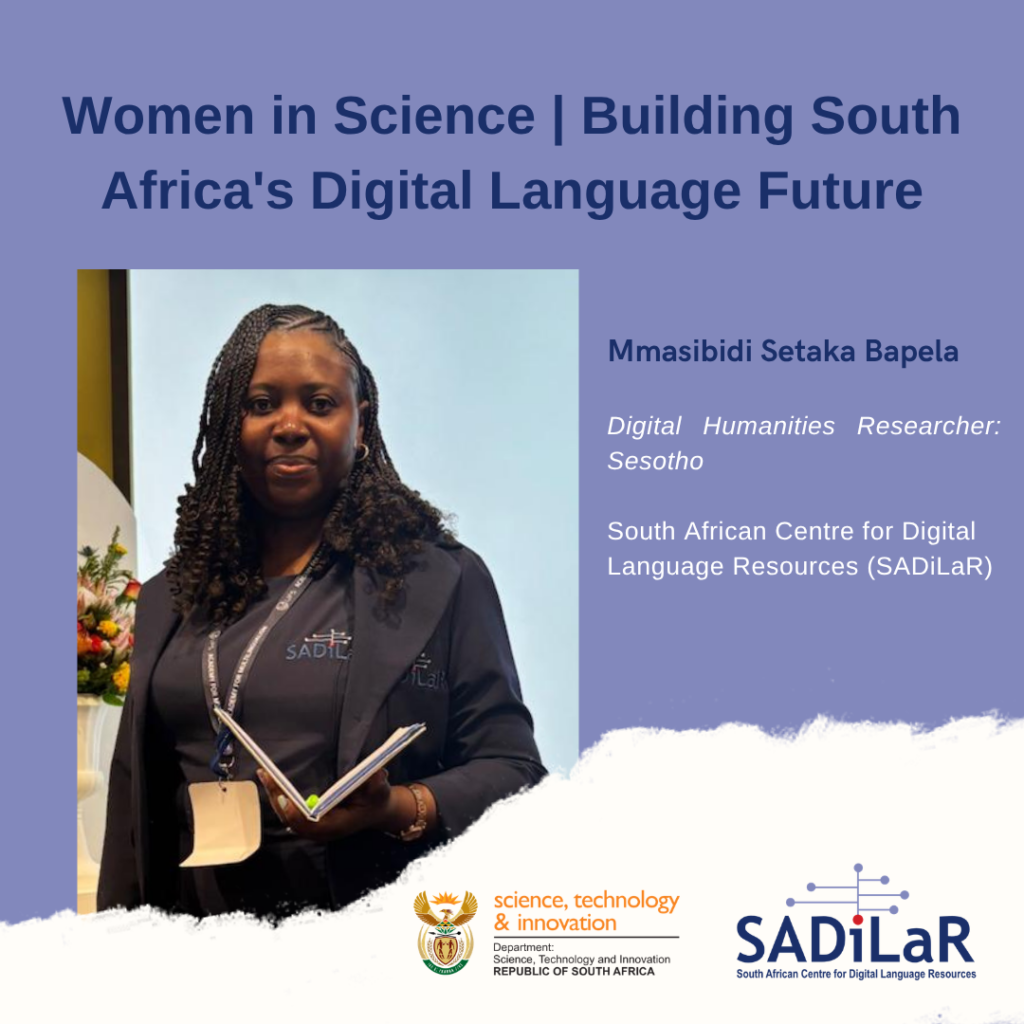
The growth of African languages in the digital age depends not only on technology, but also on the people developing the resources, conducting the research and creating new opportunities within the field. Among them is Mmasibidi Setaka-Bapela, a Digital Humanities Researcher working primarily on Sesotho, whose eight-year journey at the South African Centre for Digital Language Resources (SADiLaR) reflects the important role women play in advancing digital language resources and creating opportunities for others.
With expertise in digital humanities, lexicography and linguistics, Mmasibidi’s journey into the field began during her final year at Wits University, where a lecturer introduced her to the possibilities within the language sector, particularly the intersection of language, technology and digital resource development. At a time when there were limited opportunities in this area, she looked beyond her institution and pursued postgraduate studies at the University of Pretoria.
What began as an interest in the possibilities of language and technology has since developed into a career focused on contributing to the development and preservation of African languages through digital methods and resources.
Mmasibidi is currently involved in the South African Parliament Hansards project and the Development of the Multilingual African Riddles e-Dictionaries project, which aims to increase lexical resources in African languages while also preserving riddles and using them as a teaching and learning tool. These resources will support researchers and scholars in the humanities and social sciences, providing opportunities to examine parliamentary discourse, analyse political language and compare language use across the country’s official languages.
For Mmasibidi, the significance of this work extends beyond research. Projects such as these help ensure that South African languages are represented in the digital resources and technologies that increasingly influence research and society.
Her work also highlights the value of combining language research with technology. Through workshops on digital methods, she has been able to demonstrate to emerging language scholars what is possible when these fields intersect.
Reflecting on her journey as a woman in science, Mmasibidi identifies one of her greatest achievements as being able to show upcoming language scholars the possibilities their languages can offer them.
Her experience has taught her that progress should not be measured only by individual achievement. Instead, success should also be about creating opportunities for others and using one’s knowledge and position to open doors for those coming after.
She emphasises the importance of remaining curious, continuing to learn and recognising the enormous potential of African languages in the digital and scientific space.
The 2026 Women’s Month theme, “Building Resilient Economies for All,” speaks directly to Mmasibidi’s belief in creating opportunities that enable women to become economically independent and ensuring that women have access to the same opportunities, resources and platforms as men.
She believes women in science have an important role to play in building a more inclusive and resilient future by using their knowledge and expertise to create opportunities for themselves and others. Greater participation by women in research, technology, innovation and leadership is particularly important in fields where women and African communities have historically been underrepresented.
For Mmasibidi, leadership does not require women to conform to traditional models. She believes women can lead through empathy, collaboration and openness while remaining ambitious and decisive. “We do not have to become someone else to succeed. We can bring our own strengths, perspectives and identities into leadership. We can still lead in high heels.”
Her message to young women and girls considering careers in science, technology, digital humanities or research is simple: “Go for it!”
She encourages young women not to be discouraged when they do not see many people who look like them in a particular field. Instead, she urges them to recognise their own potential, remain willing to learn, ask questions, take opportunities and create opportunities when they do not exist.
Most importantly, she encourages young women to recognise the value of their perspectives “There is space for you in science, technology and research, take your place.” she says.
Looking ahead, Mmasibidi hopes her work will contribute to the growth and development of Sesotho, particularly in the digital space. Her motivation comes from wanting her work to form part of the change she hopes to see for African languages and future generations.
Her journey is a reminder that building resilient economies is not only about economic participation. It is also about creating knowledge, developing resources, opening doors and ensuring that communities and their languages have a place in the digital future.
Through her research, mentorship and commitment to African languages, Mmasibidi Setaka-Bapela is contributing to that future, one where language, technology and opportunity intersect, and where more women are encouraged to take their place in science and research.
Written by: Thandeka Madonsela