
17 August 2026
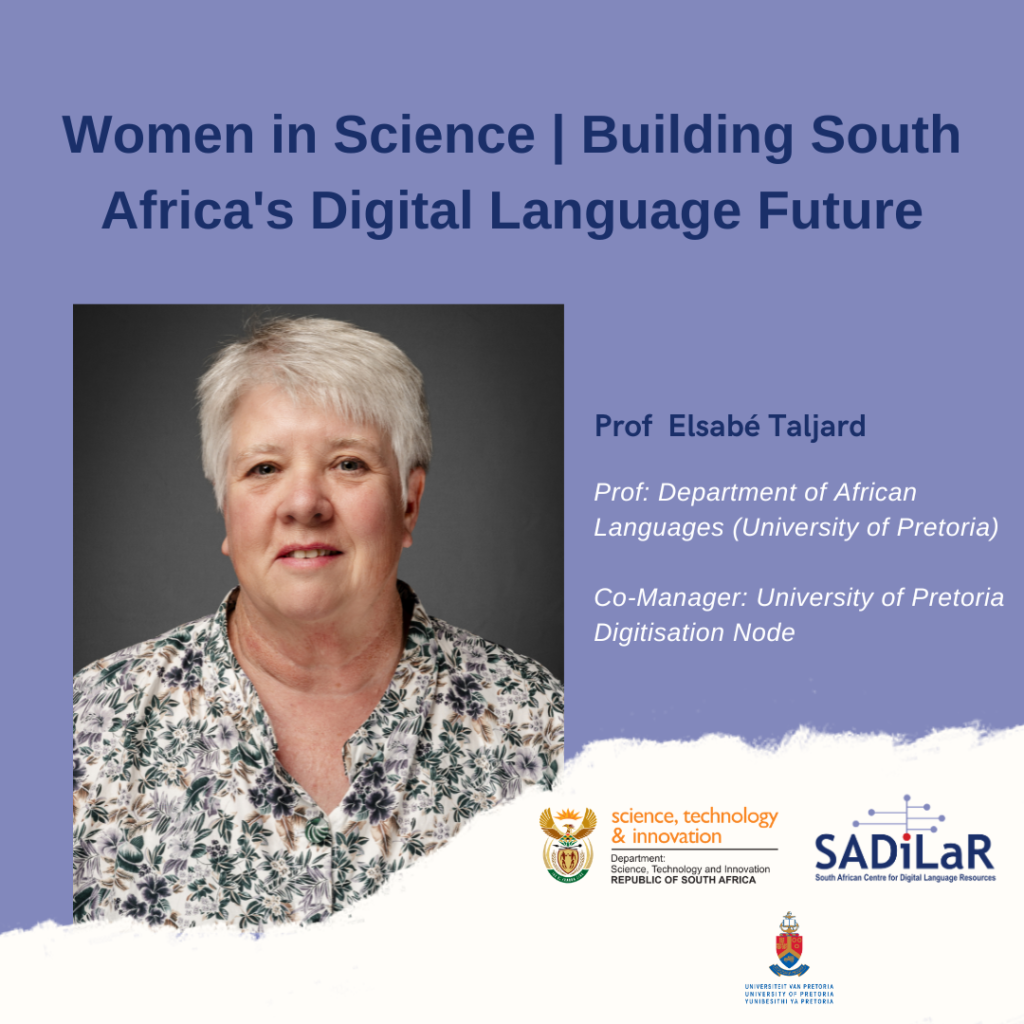
For more than four decades, Prof. Elsabé Taljard has dedicated her academic career to the study of African languages, contributing to research that places language, multilingualism and digital innovation at the heart of South Africa’s knowledge society. As a professor in the Department of African Languages at the University of Pretoria (UP) and co-manager of the UP-Digitisation Node of the South African Centre for Digital Language Resources (SADiLaR), her journey is one of perseverance, scholarship and a deep belief in the power of language.
With 45 years in academia and a decade of involvement with SADiLaR, Prof. Taljard’s career has been shaped by a lifelong passion for languages. She recalls that her decision to pursue African language scholarship was influenced by the inspiring teachers and lecturers she encountered along the way. While her primary role remains that of an academic, her contribution to SADiLaR has enabled her to support efforts to expand digital resources for South Africa’s African languages.
At the centre of her work is a challenge that extends beyond academia: addressing the digital divide between well-resourced languages and African languages that remain comparatively under-resourced in the digital environment. “By doing so, we are striving to reduce the digital divide existing between well-resourced languages and resource-scarce African languages,” she explains. Through SADiLaR, resources developed by researchers are made accessible on a shared platform, helping to advance equitable access to digital language resources for speakers of African languages.
Her professional journey has not, however, been without obstacles. Beginning her academic career in the early 1980s, Prof. Taljard experienced gender discrimination, bias and stereotyping – challenges that continue to resonate with the broader struggle for women’s equality in science and academia. Rather than allowing these barriers to define her career, she transformed them into lessons in resilience. “Fighting this kind of systemic injustice taught me perseverance, resilience, and that hard work does, in the end, pay off.”
Her achievements stand as evidence of that perseverance. Among her proudest milestones are attaining a B2 NRF rating, reflecting international recognition by her peers for the quality and impact of her research, and becoming a full professor in the Department of African Languages at the University of Pretoria.
As South Africa observes Women’s Month under the 2026 theme, “Building Resilient Economies for All”, Prof. Taljard believes women have an important role to play in shaping the future of science and society. She contends that women bring a different dynamic to science and should make full use of the advantages this perspective offers.
Her message to young women and girls considering careers in science, technology, digital humanities and research is equally direct: “Seize opportunities, take ownership and develop expertise that sets you apart. Women must use all opportunities that may come their way, take ownership of their own careers and create a niche of expertise for themselves.”
For Prof. Taljard, a successful career is ultimately about more than personal achievement. It is about leaving a meaningful legacy. Her work reflects a conviction that language is fundamental to building a society in which people can participate, connect and see themselves represented. “I believe in the power of language and the fact that language can shape and unite an inclusive society.” Her greatest hope is to be remembered for contributing to the recognition of African languages and ensuring that women take up their rightful place in the SA research community.
Prof. Taljard’s story is therefore not simply one of a distinguished academic career. It is a story about breaking through barriers, creating opportunities for others and using science to build a more inclusive future. Her journey reminds us that resilience is not only about overcoming adversity; it is also about continuing to create knowledge, opening doors and ensuring that the voices and languages of all South Africans have a place in the digital future.
This Women’s Month, SADiLaR celebrates Prof. Elsabé Taljard – a woman whose scholarship, resilience and commitment to African languages continue to help build a more inclusive and digitally empowered South Africa.
By: Lihle Sosibo