
9 September 2026
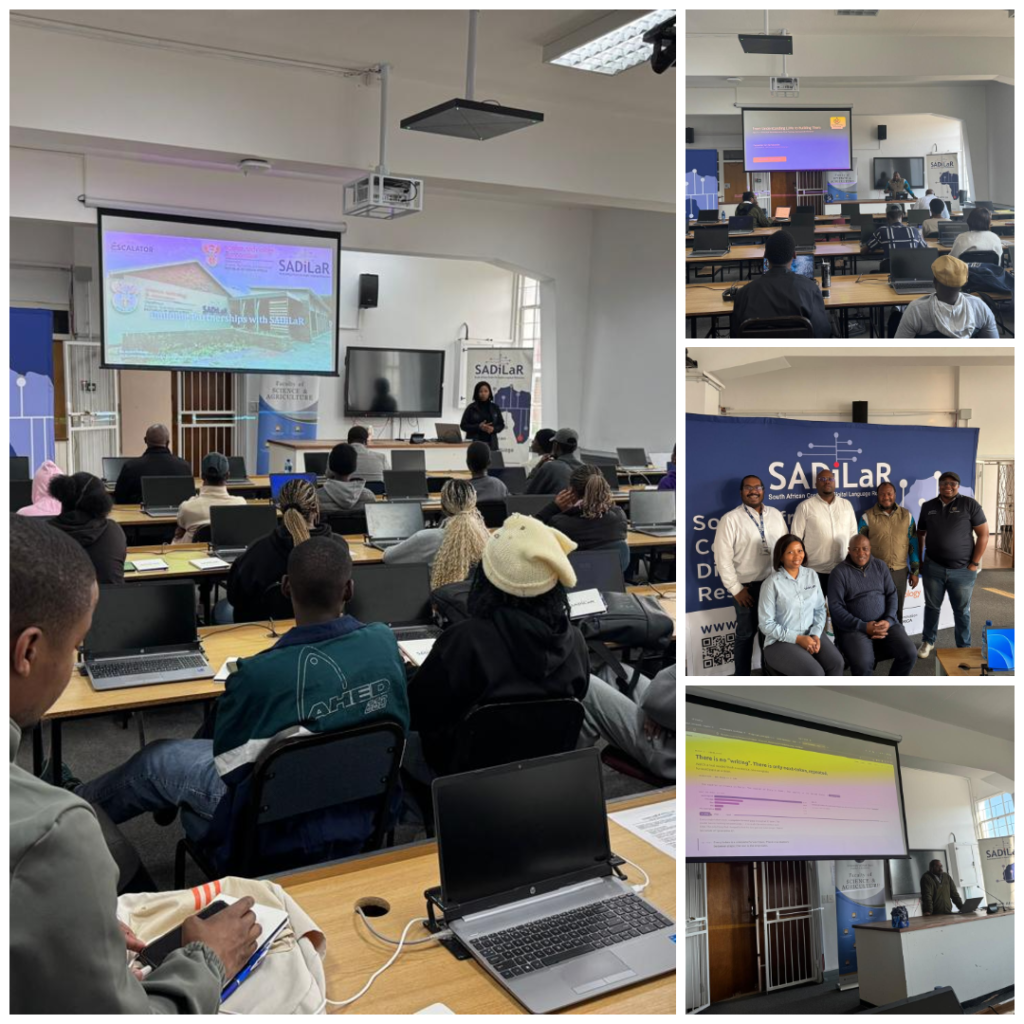
The conversation around the future of Artificial Intelligence and African languages took centre stage at the Large Language Models (LLMs) symposium held on 31 August 2026 and workshop from 1-4 September 2026, hosted by the Telkom Centre of Excellence in ICT4D at the University of Fort Hare.
Under the theme “LLMs for Low-Resourced Languages,” the event brought together researchers, academics and technology specialists to explore how AI can better serve Africa’s diverse linguistic landscape. The symposium featured discussions on data sovereignty, community-centred AI, indigenous language intelligence and the challenges faced by languages such as isiXhosa when interacting with current AI systems.
ESCALATOR programme lead, Jessica Mabaso, added to these conversations and led a session on “Building partnerships with SADiLaR.” Jessica grounded her session in a personal account of language displacement across generations before outlining SADiLaR’s mandate as a national research infrastructure, which is to ensure all twelve South African official languages can participate fully in the digital age. She detailed ESCALATOR’s capacity-building work, including the Digital Champions Initiative and the DH-IGNITE regional programme; while also and called on students from both languages and computer science backgrounds to get involved, framing the workshop itself as an example of the cross-disciplinary partnership ESCALATOR exists to build.
Privolin Naidoo from CSIR brought a strong technical dimension to the programme, facilitating several sessions across the workshop. His contributions covered GPT architecture, how Large Language Models work, advanced prompt engineering, prompt serialisation and instruction formats, AI agents and agentic workflows, Retrieval-Augmented Generation (RAG), and AI memory systems.
Together, their participation reflected the importance of bringing language expertise, research infrastructure and technical knowledge into the same conversation. The workshop provided a valuable space to move beyond simply talking about AI and begin exploring how these technologies can be developed, adapted and used to support African languages and communities.
As interest in AI continues to grow, initiatives such as this are helping to build the skills, partnerships and knowledge needed to ensure that Africa’s languages are not left behind in the digital future.
By: Nqobile Mbatha